
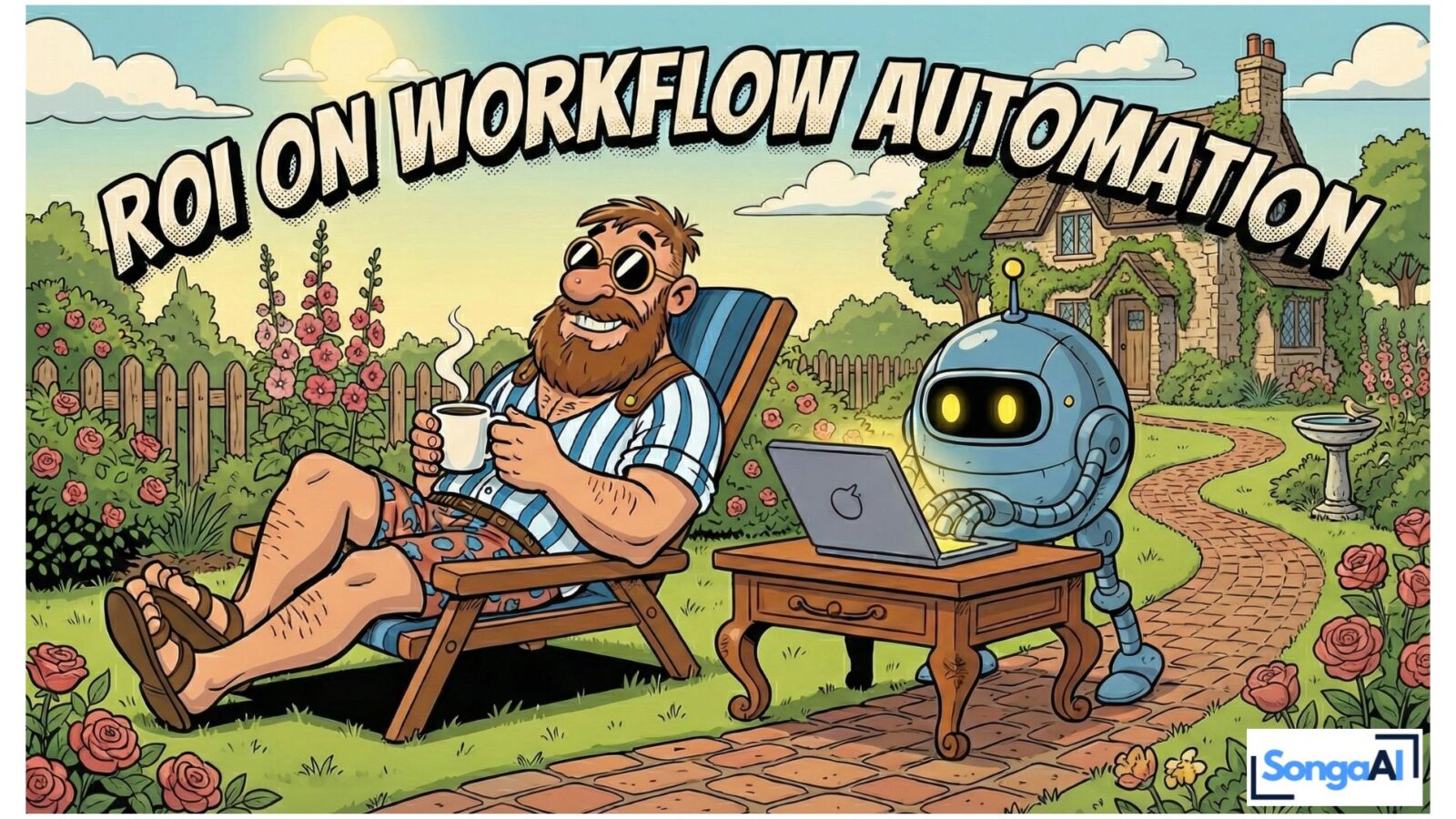
TL;DR: ROI on workflow automation isn’t about fancy tools or CFO spreadsheets. It’s about making invisible costs visible. Manual work feels cheap, until you realize how much time, focus, and revenue quietly disappear every week. This article breaks down how ROI on workflow automation actually works in real businesses, without finance jargon or guesswork.
The Real Question Behind ROI on Workflow Automation
When people hear “ROI on workflow automation,” they picture spreadsheets, formulas, and long meetings. Calculator apps get opened. Eyes glaze over. Someone mentions “payback periods” and everyone’s checking their phones.
But here’s the thing: the real question is way simpler. What is my current way of working actually costing me?
Manual work doesn’t show up as an invoice. It doesn’t trigger alerts or complain. It just quietly eats time, creates friction, and limits growth. That’s why ROI on workflow automation gets underestimated, not because automation is expensive, but because manual work hides its price really well.
Why Manual Work Feels “Free” (But Isn’t)
Most small businesses track the obvious stuff. Software subscriptions? Check. Marketing spend? Tracked monthly. Staff salaries? Right there on the payroll.
But manual processes? They slip through like ninjas. Copying data between tools. Adding “follow up later” to the mental to-do list (spoiler: you won’t remember). Fixing typos that cascaded through three systems. Searching for information that should’ve been logged automatically. Repeating the same task over and over, Groundhog Day style.
Each action seems harmless. Five minutes here, ten there, no biggie, right? Wrong. Together, they form what I call the “invisible operational tax.” And trust me, this tax rate is higher than anything the IRS dreams up.
Understanding ROI on workflow automation starts here: time spent on repeatable work isn’t neutral. It’s an active cost that compounds daily. When you dive into workflow automation for small business, this becomes your foundation for real transformation.
The Four Hidden Cost Layers That Kill ROI
Let’s get concrete. There are four cost layers most businesses never account for properly.
1. Time & Labor Cost (The Obvious One You’re Still Underestimating)
Every manual task eats paid time. Five minutes copying data. Ten minutes sending follow-ups. Random interruptions daily because “Hey, can you just quickly…?”
Those minutes turn into hours weekly. Days monthly. Weeks yearly. What makes this dangerous? The repetition. Automation doesn’t save time once, it saves the same time over and over, like productivity compound interest that actually works.
Quick math: 30 minutes daily on manual data entry = 2.5 hours weekly = 130 hours yearly. That’s more than three full work weeks spent copy-pasting. Three weeks! You could learn a language in that time.
This is where no-code automation examples become game-changers, set up time-saving workflows in hours, not weeks.
2. Error & Rework Cost (The Silent Killer)
Uncomfortable truth: manual work introduces variability. Typos happen. Follow-ups get missed. Wrong data lands in wrong fields. Communication gets inconsistent.
Here’s the kicker, fixing mistakes usually costs more time than doing it right the first time. ROI on workflow automation improves dramatically when error-correction loops disappear. Not because people become perfect, but because systems don’t get tired, distracted, or rushed.
How many “Sorry, correction on my last email” messages have you sent? How often do errors cause problems before anyone catches them? These aren’t just annoying, they’re expensive. Each correction takes time, sometimes multiple back-and-forth rounds.
When you implement solid workflow automation for small business operations, errors don’t just decrease, they often drop to near zero for automated tasks.
3. Opportunity Cost (The Most Expensive One Nobody Tracks)
This is the big one. Every hour on busywork is an hour NOT spent on things that actually grow your business. Sales conversations. Client relationships. Strategic thinking. Creative problem-solving. New revenue streams.
ROI on workflow automation isn’t just saving money, it’s redirecting your expertise toward activities that multiply in value instead of just checking boxes. This is where AI automation for business gets particularly powerful, AI handles increasingly complex tasks, freeing you for higher-value work.
Missed opportunities don’t show up in reports. But they absolutely define your long-term growth. Think about the last time you thought “I should reach out to that potential client” but didn’t because you were buried in admin tasks. That’s opportunity cost eating away at your potential.
4. Human Cost (Burnout & The Sanity Tax)
Let’s talk about something that rarely makes ROI calculations: repetitive work drains energy, motivation, and morale.
Teams don’t burn out from hard work. They burn out from meaningless repetition. From doing the same low-value task for the 47th time this week. From feeling like a human robot.
Automation removes the frustrating parts that make people dread Mondays. This stabilizes performance and consistency in ways spreadsheets can’t capture. Happy, engaged team members are more productive, make better decisions, and stick around longer. That’s real ROI.
What ROI on Workflow Automation Actually Looks Like
ROI on workflow automation isn’t about buying software and hoping for magic. It’s about changing how work flows through your business.
When workflows are automated: tasks run the same way every time, information arrives where it’s needed without manual intervention, follow-ups happen on schedule, and errors get reduced structurally through design.
The return comes from eliminating friction at every touchpoint. It’s like upgrading from a bumpy dirt road to a smooth highway. Same destination, way better ride.
A Real Example: Before and After
A potential lead fills out your contact form at 9:47 PM on Tuesday.
Without automation: Email notification sits in an inbox. Someone sees it next morning around 10 AM. Response happens hours later. Follow-up? Depends if anyone remembers.
With automation: Lead gets instant acknowledgment within seconds. Info automatically logs in your CRM with everything tagged. Follow-up sequence triggers immediately with perfectly timed messages. Your team gets a notification with all the context compiled.
The difference isn’t dramatic once. It’s dramatic after the 100th lead. That’s how ROI on workflow automation compounds, consistent excellence multiplied over time.
Why ROI Shows Up Faster Than You Think
Most businesses assume automation ROI takes months. Reality? First returns often appear within weeks, sometimes days.
Why? Because smart automation targets high-frequency tasks first. Lead handling. Email sorting. Appointment reminders. Data syncing.
When something happens dozens of times weekly, even small improvements add up fast. Five minutes saved fifty times weekly = over four hours reclaimed, half a workday, every single week. ROI on workflow automation accelerates when repetition is high.
The Long-Term ROI Nobody Mentions
Automation doesn’t just save resources now, it stabilizes operations for the future. Stable systems scale easier, onboard faster, and adapt quicker to changes.
This ROI doesn’t show up as a neat line item. It shows up as resilience. Businesses with automated workflows don’t scramble when volume increases, they absorb it smoothly. They don’t fall apart when key people vacation. That’s the ROI that transforms businesses from fragile to antifragile.
A Practical Example That Makes This Real
Small service business automates three areas: lead intake, appointment reminders, client follow-ups.
Immediate effects (week one): Response times drop from hours to seconds. Missed appointments decrease dramatically. Admin work drops by several hours weekly.
Long-term effects (months later): Client trust increases from consistently fast communication. Client experience improves significantly. Revenue becomes more predictable because fewer leads fall through cracks.
This is ROI on workflow automation in action, not just cost savings, but experience improvements that drive growth. Want to see how this works for your situation? Book a free automation audit with SongaAI and we’ll map out exactly where automation could transform your operations.
Why “Not Automating” Is Still a Decision
Doing nothing isn’t neutral. It’s not playing it safe. Choosing not to automate is actively choosing to keep manual friction, accept inconsistency, and limit scalability.
ROI on workflow automation becomes obvious when you flip it: what’s the ROI of staying manual? For most businesses, that number is negative and getting worse as competitors automate and pull ahead.
Final Thought: ROI Is a Side Effect of Clarity
The strongest automation ROI doesn’t come from fancy tools or complex workflows. It comes from clarity, knowing exactly what happens, when, and why in your operations.
Clear triggers. Clear outcomes. Clear ownership. Once workflows are visible and repeatable, ROI follows naturally. That’s why ROI on workflow automation is less about specific tools and more about how intentionally you design the work itself.
Ready to Calculate Your Real ROI?
Stop guessing, start measuring. Book a free automation audit with SongaAI and we’ll identify exactly where you’re losing time, money, and opportunities, plus create a concrete plan to get them back.
Your next steps:
- Start your free automation audit here
- Learn more about workflow automation for small businesses
- See 5 powerful no-code automation examples in action
- Explore AI automation for business tools and workflows
The question isn’t whether automation delivers ROI, it’s how fast you want to start seeing it.